
Why spreadsheet-based commission management fails at scale
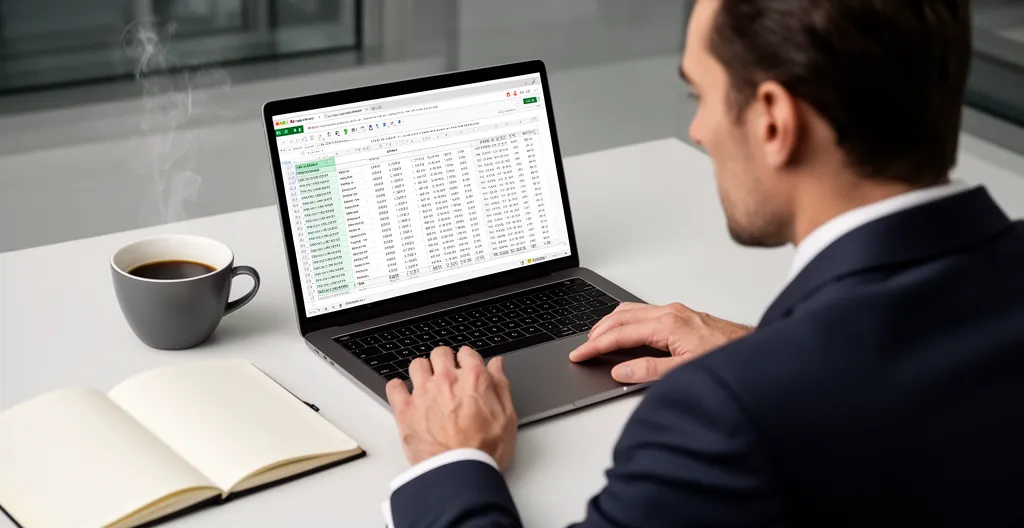
The fundamental problem with Excel-based commission management is not complexity—it is fragility. Every VLOOKUP, every conditional formula, every manual data entry creates a potential failure point. When your sales team grows beyond 20 representatives, these failure points multiply exponentially.
8-12%
Average error rate in monthly commission payouts using spreadsheet calculations
In my work with GTM teams across US, UK and Western Europe (approximately 35 implementations between 2021-2025, typically 20-200 sales reps), spreadsheet-based commission calculations consistently generate 8-12% error rates in monthly payouts. Reconciliation alone consumes 3-5 days per cycle. This matters. Every disputed commission erodes trust between your sales team and operations. Every correction cycle delays strategic work.
Hidden operational cost: The most common mistake I encounter is underestimating dispute resolution time. Commission queries do not simply consume Finance hours—they distract sales managers, delay pipeline reviews, and create tension across your entire GTM organisation. One disputed commission can generate 4-6 hours of cross-functional time.
The market analysis from Future Market Insights projects the sales compensation software sector will grow from USD 3,473.4 million in 2025 to USD 8,927.5 million by 2035. This growth reflects a market-wide recognition: manual processes cannot scale.
How Qobra transforms sales compensation operations
The limitations established above—calculation errors, reconciliation burdens, transparency gaps—represent precisely the operational challenges that modern sales compensation software addresses. The Qobra platform approaches this through a four-stage automation framework that replaces manual processes with systematic workflows.
Qobra automation framework
- Integration — Connect Qobra to your existing CRM (Salesforce, HubSpot) and data warehouses through native integrations. This eliminates manual data transfers that create version conflicts and entry errors.
- Automation — Complex commission calculations run automatically with 100% reliability. Multi-tier structures, accelerators, and SPIFs calculate without formula maintenance or manual intervention.
- Visibility — Real-time commission access for all stakeholders. Sales representatives see their earnings update live. Operations monitors plan performance. Finance tracks liability positions.
- Optimisation — Performance insights enable data-driven plan adjustments. You can model scenarios before implementation rather than discovering problems post-payout.
Case study: Series B fintech, 85 sales representatives
A US-headquartered fintech (Series B, 85 sales reps) was spending USD 57,000 annually on manual reconciliation processes. Their Finance team allocated 40+ hours monthly to commission dispute resolution. Three sales team resignations specifically cited commission transparency concerns. Following Qobra implementation in Q3 2024, disputes reduced by 92% and monthly reconciliation time dropped to 4 hours. The operational transformation freed their RevOps team for strategic plan design work.
The measurable outcomes from Qobra deployments include 5 days per month saved on average in commission management, +15% average sales performance improvement, and 100% calculation reliability. These figures represent operational capacity that returns to value-generating activities rather than administrative correction.
Implementation reality: timelines and integration requirements
Vendor marketing often promises 2-4 week implementations. Reality differs. The implementations I’ve observed show consistent timelines of 8-10 weeks for mid-market deployments. This is not a criticism—it reflects the genuine complexity of commission system transitions.
- Discovery and commission plan documentation
- CRM and data warehouse integration setup
- Commission rules configuration and testing
- Parallel run with existing system
- Full deployment and team onboarding
Based on 25 mid-market implementations in the US during 2024-2025, this timeline represents realistic planning. Rushing integration phases creates downstream configuration problems. Skipping parallel runs risks payout errors during transition.

When NOT to implement: If your sales team has fewer than 15 representatives and uses simple flat-rate commission structures, automation may be premature. The implementation investment typically requires complex multi-tier plans or significant team scale to generate positive ROI within 12 months. Assess honestly before committing.
Measuring ROI: what executive teams actually track
The challenge with commission management ROI is that different stakeholders measure success differently. Operations tracks efficiency. Sales tracks motivation. Finance tracks accuracy and control. According to automation ROI data from MarketsandMarkets, companies leveraging sales automation report 10-20% ROI increases while reducing human errors by 20%.
The following comparison shows how each function evaluates sales compensation software investment. This framework helps you build cross-functional business cases that address all executive stakeholders.
| Function | Primary Metrics | Typical Improvement |
|---|---|---|
| Operations | Processing time, dispute volume, audit readiness | 70-80% time reduction |
| Sales | Commission visibility, payout accuracy, trust scores | 15-20% performance lift |
| Finance | Calculation accuracy, liability forecasting, compliance | 100% error elimination |
The compensation statistics from Everstage indicate the incentive compensation management market will reach USD 8.97 billion by 2033, growing at 16.76% CAGR. This trajectory reflects enterprise recognition that manual processes create unacceptable operational risk.
The real question now: does your current commission process create more problems than it solves? If your answer involves words like “workaround,” “exception,” or “that one spreadsheet,” you already know.